







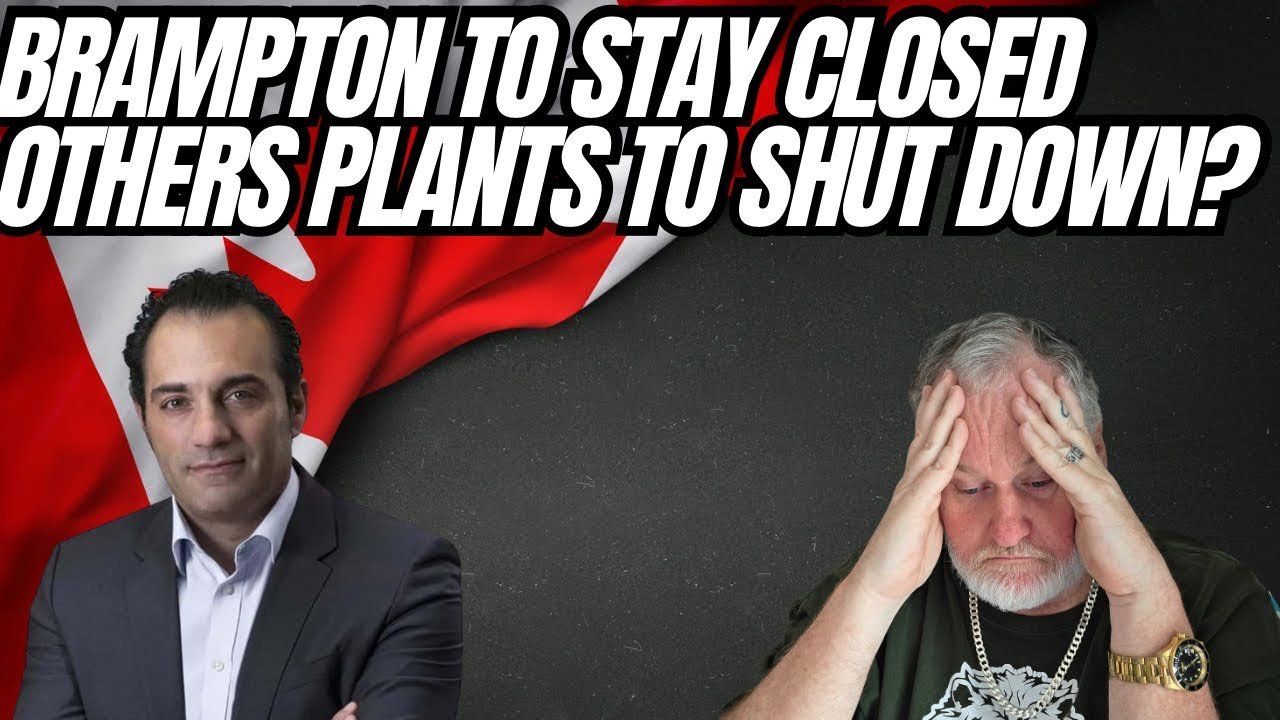
Brampton’s Future Goes Dark as Stellantis Shifts Output to the U.S.
CEO Antonio Filosa touts a $13B U.S. build-up, sidesteps Canada/Mexico closures, and leaves Brampton workers bracing for a long freeze.
Stellantis’ new CEO Antonio Filosa hit CNBC to trumpet a $13 billion investment in U.S. manufacturing—“the largest single investment in our more than 100-year history.” The plan: five all-new products, one new engine, 19 product actions, and a 50% ramp in U.S. output over four years across Jeep, Ram, Dodge, and Chrysler.




But behind the confetti, one plant heard a deafening silence: Brampton Assembly.
When asked point-blank whether production in Mexico and Canada would be shut down, Filosa ducked, pivoting back to the American expansion—5,000 direct jobs, ~20,000 supplier jobs—without addressing the fate of Brampton or Windsor. That non-answer tracks with what we’ve been reporting for months: Brampton is effectively mothballed with no product on deck as Stellantis redirects programs to U.S. sites.
What’s shifting—and where
- Belvidere & Toledo: The new midsize Ram on the Gladiator architecture is slated for Toledo, while Belvidere roars back with multiple Jeep/Ram actions after years in limbo.
- Warren Truck: Prepping a full-size Ram SUV (widely expected to adopt the Ramcharger nameplate) on the Wagoneer/Grand Wagoneer bones.
- Charger/Durango: Charger production remains in Windsor for now, but the next-gen Durango is tagged for Detroit—and not soon.
- Saltillo (Mexico): Heavy-duty/truck output faces mounting tariff friction for U.S.-bound units; any long-term Mexico calculus hinges on policy and pricing.
Meanwhile, Unifor is already sounding alarms, seeking buyouts and clarity as retooling assets quietly disappear and surrounding Brampton parcels get sold off. Even Windsor is getting antsy, aware that a 50% U.S. output surge inevitably cannibalizes non-U.S. volume.
Why the answer matters
Filosa’s headline—“It’s all about the U.S.”—isn’t just PR. It implies:
- U.S. product bias through 2029: Jeep and Ram soak up four of the five “all-new” launches, leaving one slot to fight over between Dodge and Chrysler.
- Tariff math overrules nostalgia: Keeping Hemi engines in Mexico while ramping Hemi-equipped U.S. vehicles invites cost pressure until/unless engines move stateside (no commitment given).
- Brampton timeline slips to the horizon: With tooling pulled and no program assigned, no realistic output before 2029–2030—if ever.
The tell in his Hemi talk
Filosa highlighted that returning the Hemi to Ram booked ~10,000 orders day one—a rare on-air stat. Yet he stopped short of promising broader Hemi proliferation, a U.S. Hemi line, or Dodge allocations beyond acknowledging an ICE Charger. That selective enthusiasm suggests Hemi is a near-term lever, not a locked-in strategy.
What it means if you work at—or sell out of—Brampton
- Workers: Plan as if Brampton is idled indefinitely. If Stellantis retains the real estate, a future program isn’t impossible—but nothing arrives before the decade’s end under the current roadmap.
- Suppliers/Dealers: Rebalance toward U.S. plants (Toledo, Warren, Detroit, Belvidere). Expect parts flow and logistics to re-center south of the border.
- Consumers: More U.S.-built Jeeps/Rams, sharper pricing claims on new launches, and a wait-and-see on Dodge beyond Charger/Durango.
The near-term watchlist
- Formal Brampton status: Any notice, even phrased as “temporary stand-down,” would confirm what’s already happening off-camera.
- Engine localization: A concrete plan to assemble Hemi (or successor V8) in the U.S. would validate the pricing talk and de-risk tariffs.
- SEMA reveals: Direct Connection programs, Ram’s full-size SUV details, and whether Dodge secures that fifth “all-new” slot.
- Canadian labor moves: Unifor negotiations, buyout packages, and Windsor contingency actions.
Bottom line: Filosa’s $13B U.S. splash lands real jobs and product—but it also casts a long shadow over Canada. With no product assigned, assets pulled, and the CEO refusing to defend its future, Brampton is—functionally—done for the foreseeable future.