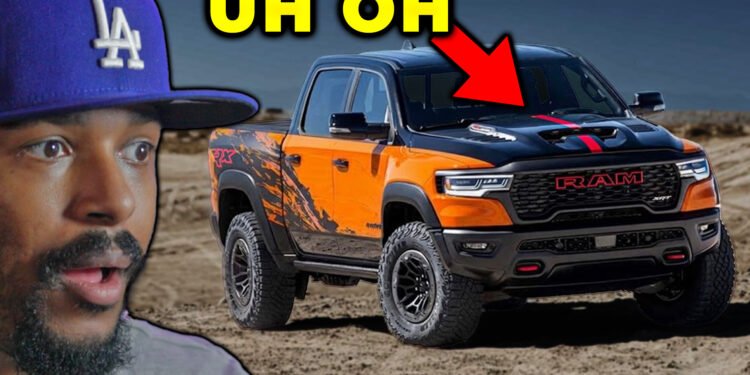



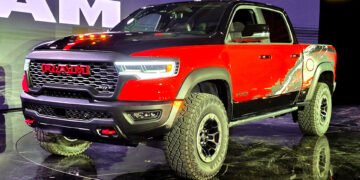




The news is out, and the excitement is building. Specifically, the Dodge Ram Dakota is returning to the US market. However, production likely won’t start until roughly 2027. This return is certainly a move in the right direction for the brand. In fact, fans have sent countless messages asking for this truck. I personally think it is great news. Yet, there is one major concern that we cannot ignore.
Tim Kuniskis has indicated that the starting price will be around $40,000. Unfortunately, that number puts a wet blanket over this entire announcement. As a result, people are already screaming in the comments section. Their argument is simple and mathematically sound. Currently, you can buy a full-size truck for that same money. Consequently, this pricing strategy creates an immediate conflict within the showroom floor.
The Internal Competition Problem
I went directly to the Ram website to verify the numbers. Currently, you can get a Ram 1500 Tradesman Quad Cab 4×2 for $41,575. Surprisingly, that is a full-size machine for nearly the same projected price as the midsize Dakota. Therefore, the value proposition becomes murky immediately. Why would a buyer spend full-size money on a smaller vehicle? Clearly, this overlap is a legitimate problem.



Once you start adding basic options to the Dakota, the price will climb. For example, if you want a steering wheel and some tires, you pay more. Realistically, adding necessary packages will push the price toward $50,000. Consequently, a fully loaded midsize truck approaches the mid-$50,000 range. That price point is a non-starter for many buyers. After all, there are simply too many other options available at that level.
Engine Specs vs. Price Tag
Another issue is what lives under the hood. Reports suggest engineers will likely jam a four-cylinder engine into this truck. Additionally, a hybrid powertrain is probable. If they stuck the Hurricane engine in it, the $40,000 price might make sense. That would justify the cost with serious performance. Unfortunately, we are probably looking at a four-cylinder setup.
Ideally, the truck will still be fast. It will likely be a good truck overall. However, $40,000 for a four-cylinder base model feels too high. Value is key in this segment. If Ram wants to compete, the equipment must match the price tag. Currently, the spec sheet does not seem to align with the proposed MSRP.
Sales Strategy and Volume Goals
On the other hand, there is a shifting strategy at Stellantis. Antonio Filosa is reportedly cutting loose on profit margins to focus on moving units. This shift could mean that the $40,000 base price is just a starting point for negotiations. In fact, we might see significant discounts immediately after launch. We are heading into a world where heavy incentives offset high sticker prices.
Consider the alternative scenario. If the price is too low, dealers ruin the experience. For instance, look at the Ford Maverick launch. The price was incredibly low, which drove massive demand. Consequently, dealers added $5,000 markups everywhere. They played the inventory game. Now, those loans trap many buyers.
Starting with a higher MSRP might prevent that specific issue. If Ram sets the price high, they can control the final transaction price with factory incentives. Effectively, this cuts the dealer out of the markup game. Also, it allows the manufacturer to dictate the discount. Ultimately, this might be the safer play for consumer satisfaction.
Crushing the Competition
To truly disrupt the market, Ram needs to be aggressive. Specifically, they need to smack Ford. For comparison, the Ford Ranger starts between $33,000 and $35,000. However, once you add options, the Ranger quickly hits $40,000 or $47,000. A Ranger Lariat hits $53,000. The pricing ladder climbs fast in this segment.
Nevertheless, Ram should aim lower. They should get the base price closer to $30,000. Specifically, a $30,000 to $32,000 starting point would be a game-changer. Then, a fully loaded model could sit at $42,000. That would completely disrupt the market. Indeed, it would bring Ram back into the mix with serious strength.
Furthermore, consider the Toyota Tacoma. It is an expensive truck. Yet, people still cross-shop it. Some buyers claim they don’t need a full-size truck. Instead, they prefer the smaller footprint. However, others point out that you can get a Ram 2500 for less money than some Tacoma trims. The towing capacity of a four-cylinder midsize truck is also a limiting factor. You likely wouldn’t tow a race car trailer with a four-cylinder Tacoma. Similarly, you probably won’t with a four-cylinder Dakota either.
The Final Verdict on Pricing
Ram has a massive opportunity here. The Dakota nameplate carries weight. But pricing remains the hurdle. If they launch at $40,000, they risk alienating the core customer base. For example, who would choose this over a Tacoma? Or, who would choose this over a discounted Ram 1500?
Ideally, buyers want a fully loaded truck for under $50,000. That needs to be the ceiling. If the sticker screams past $55,000, sales will slow down. After all, the market is sensitive right now. Affordability is the main driver for midsize truck buyers. Therefore, Ram must recognize this.
In conclusion, the return of the Dakota is exciting news. But the execution is critical. Is $40,000 too high for a starter truck? Conversely, should they push the envelope to hit $30,000? Let me know what you think. Would you buy one with a steering wheel for $50,000? Or would you go get a Tacoma? Ultimately, the ball is in Ram’s court.