



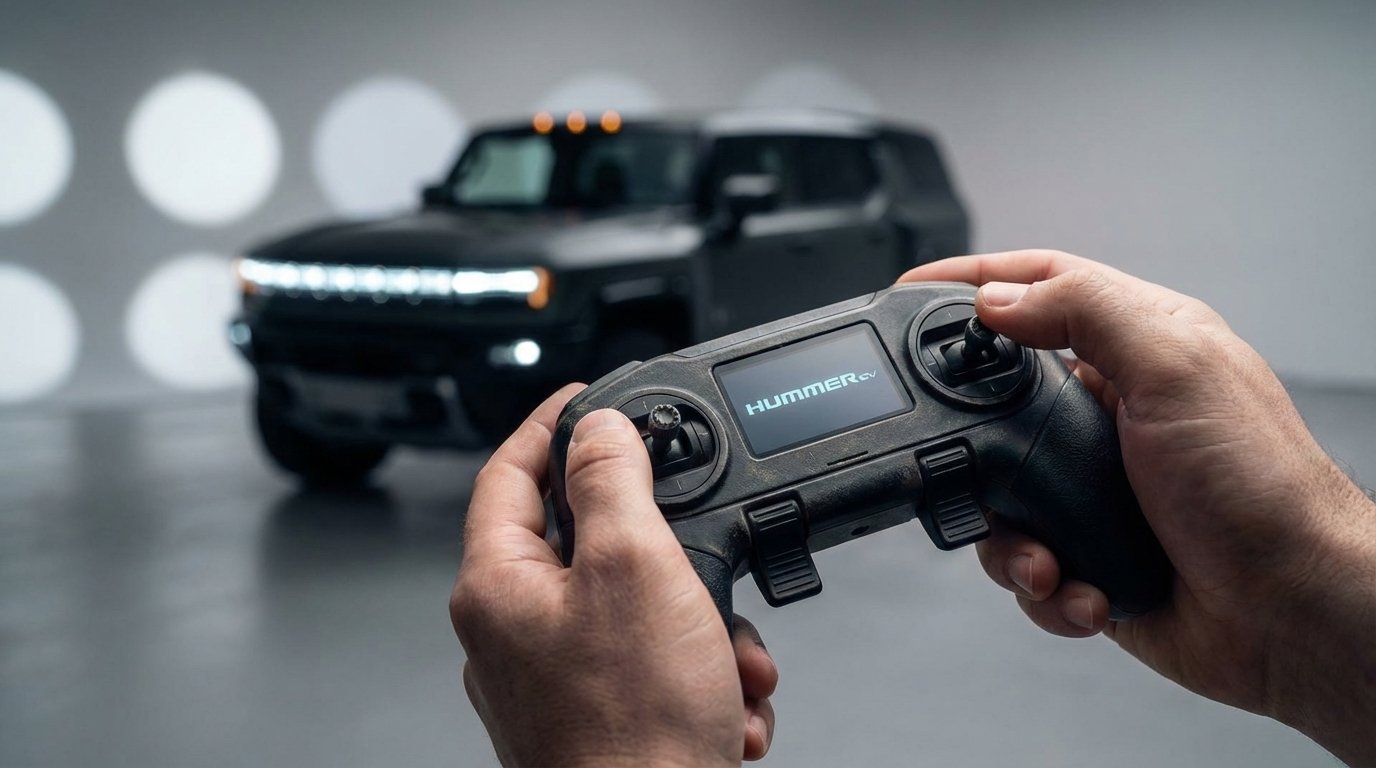
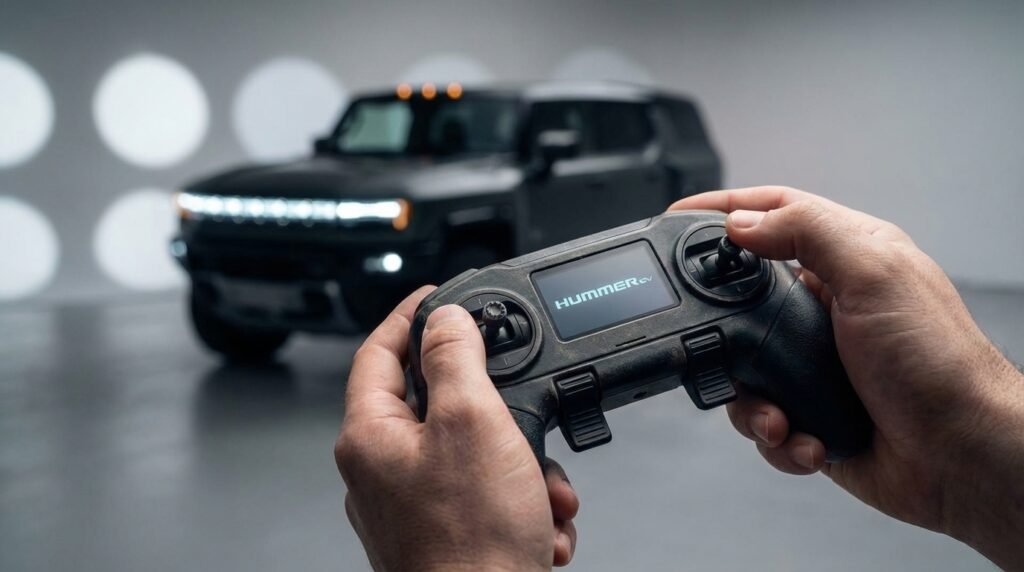
Remote vehicle control is suddenly much closer to reality, and General Motors recently drew attention with a patent application that many outlets have reported online. Reporters describe a system that would let an owner guide their vehicle from outside using a handheld controller, and some sites list a file number often cited in coverage. However, the public record around that exact publication number remains unclear, so reports rather than confirmed USPTO listings form the basis for most summaries. Still, the core idea is straightforward: replace or supplement in-cabin controls with a dedicated, low-latency input device that maps human gestures to steering, throttle, and braking commands. As a result, users could perform tight low-speed maneuvers without sitting in the driver’s seat. Moreover, the proposal reads like a bridge between current remote-start and advanced drive-by-wire systems. Ultimately, this patent application has reignited debates about convenience, control, and risk.
Remote Vehicle Control: Deconstructing the Tech
Reports of the patent sketch a system that is far more than a smartphone trick and instead leans heavily on hardware and vehicle integration. First, the application emphasizes precise, analog-style input rather than coarse touchscreen taps, and it pairs those inputs with sophisticated calibration maps. Next, engineers would translate controller motion into actuator commands using onboard processors that prioritize low latency and safety. In addition, the documents reportedly reference existing drive-by-wire components such as electronic throttle control and electric power steering, which already accept digital commands. However, the novelty lies in creating a primary external input source that a vehicle treats as trusted while it performs slow, complex maneuvers. Therefore, the design concentrates on accuracy over speed, with sensors and feedback loops that aim to keep responses predictable and repeatable. In fact, the system appears optimized for confined or controlled environments rather than open-road driving.
The Controller: More Xbox Than Car Key
At the heart of the proposal is a portable controller that several reports say resembles a modern video game pad and that prioritizes fine-grain input. For example, dual analog sticks could allow graduated steering and throttle control, while triggers and switches would manage braking and mode selection. Additionally, haptic feedback and ergonomic placement would give users tactile cues about vehicle state. Gamers already trust analog sticks for nuance, and the same principle could translate into millimeter-accurate steering adjustments. Moreover, the patent reportedly outlines calibration schemes that map stick travel to steering angles and pedal demands, so small wrist motions result in small vehicle responses. Consequently, users might guide a truck into a tight spot with far more precision than current smartphone park-assist tools permit. Finally, manufacturers could lock or pair controllers to specific vehicles to reduce misuse.



The Brains in the Car: How it Works
The vehicle side of the system relies on robust onboard computing to receive, validate, and enact remote commands while continuously monitoring safety systems. First, wireless telemetry from the controller would arrive at a vehicle gateway and then flow to secure processors that check signal integrity. Next, the system would convert validated inputs into digital commands for existing actuators, for instance steering motors, electronic throttle units, and brake-by-wire modules. In addition, redundancy and sensor fusion would verify that commanded motions do not conflict with obstacle detection or stability controls. Therefore, the vehicle could override unsafe inputs or limit actions when sensors report risk. Meanwhile, the whole loop must operate within tight timing constraints to feel responsive, and designers would likely focus on low-speed operation to minimize hazards. In short, the car becomes an intelligent executor of externally sourced, owner-authorized instructions.
The Real-World Mission: Why Build a Car-Sized RC Car?
Beyond novelty, reported use cases outline several practical scenarios where precise remote control adds clear value. For instance, parking in very tight urban garages becomes less stressful because an owner can exit and guide the vehicle into place, which reduces door-dings and awkward positioning. Similarly, hitching trailers is a common pain point that remote control could solve by letting a single person walk behind and align the hitch visually while adjusting the truck from outside. Moreover, commercial conveniences also appear in the discussion: remote positioning could streamline moving vehicles in service bays, car shows, or crowded paddocks. In addition, owners with mobility limitations might find value in being able to reposition a vehicle without climbing in. Therefore, the technology targets real friction points in everyday driving rather than pure spectacle.
Beyond the Suburbs: Heavy-Duty, Agriculture, and First Responders
Reports further argue that commercial and industrial uses may form the strongest early markets because controlled environments lower regulatory friction. For example, construction crews could remotely place heavy equipment with surgical precision while keeping operators at a safe distance, which would reduce injury risk. Likewise, farmers might guide tractors or combines around obstacles without being exposed to dust or noise. In addition, military units and first responders could use remote control to send vehicles into hazardous zones for reconnaissance, resupply, or ordnance handling, thereby protecting human lives. Consequently, precision remote control becomes not just convenient but potentially lifesaving in certain scenarios. Finally, companies often adopt such features first on specialized fleets, where they can prove safety before consumer rollout.
Performance and Off-Roading Uses
Performance and off-road communities also see niche but compelling benefits, according to coverage of the patent. For instance, off-roaders could let a spotter stand outside the vehicle, observe all wheels, and drive the vehicle through technical obstacles with greater accuracy than in-seat guidance allows. Moreover, motorsport teams could use remote movement to reposition race cars in paddocks or during pit procedures, which would save time and reduce physical strain on crew members. In addition, controlled low-speed remote control could aid vehicle recovery operations on rough terrain, where visibility from the cabin is limited. Therefore, while high-speed remote driving remains implausible, targeted performance and service applications could offer significant utility.
The Elephant in the Room: Let’s Talk Security
Security is the single largest barrier to any meaningful deployment, and reports note that the patent application offers limited public detail on defensive measures. First, the wireless link between controller and vehicle represents an obvious attack surface that could be targeted for interception, jamming, or replay attacks. Next, a man-in-the-middle exploit could let an attacker insert commands or block the owner’s input, which would create extreme safety risks. Consequently, any viable product must adopt strong, multi-layered security: robust encryption, mutual authentication, continuous session validation, and fail-safe behavior on signal loss or tampering. In addition, designers should require geofencing, speed limits, and operational envelopes that prevent hazardous use. Finally, transparency about security testing and third-party audits will be necessary to build public trust before broad adoption.
The Road Ahead: Is This Coming to Your Next Corvette?
A patent filing signals interest, not inevitability, and many concepts never reach production. For one thing, federal regulators and safety agencies will demand comprehensive evidence that remote operation cannot harm people or property, and companies will need to satisfy those standards. Moreover, public acceptance depends on provable security and predictable, fail-safe behavior. Therefore, an incremental rollout seems likely: start with industrial fleets and controlled environments, then extend to specialized consumer models as evidence accumulates. In addition, manufacturers may limit remote modes to low-speed scenarios and require owner presence for higher-risk moves. Ultimately, the path from patent sketches to dealer lots runs through regulation, rigorous testing, and consumer trust-building.
Final Take
GM’s remote vehicle control concept offers a striking glimpse of how interaction with cars might evolve, and it highlights both clever engineering and grave responsibility. On one hand, the proposed controller-and-vehicle system promises real-world conveniences like perfect parking, easier trailer hookups, and safer equipment positioning. On the other hand, security and regulatory hurdles remain immense, and the industry must prove that wireless control cannot be exploited. Therefore, the success of any implementation will hinge on airtight encryption, rigorous validation, and conservative operational limits. In fact, the safest route likely begins with commercial and industrial deployments where environments are controlled and risks are lower. Ultimately, if manufacturers can demonstrate near-perfect security and dependable fail-safes, remote vehicle control could change how we use vehicles; if not, it will remain an intriguing patent rather than a practical feature.