


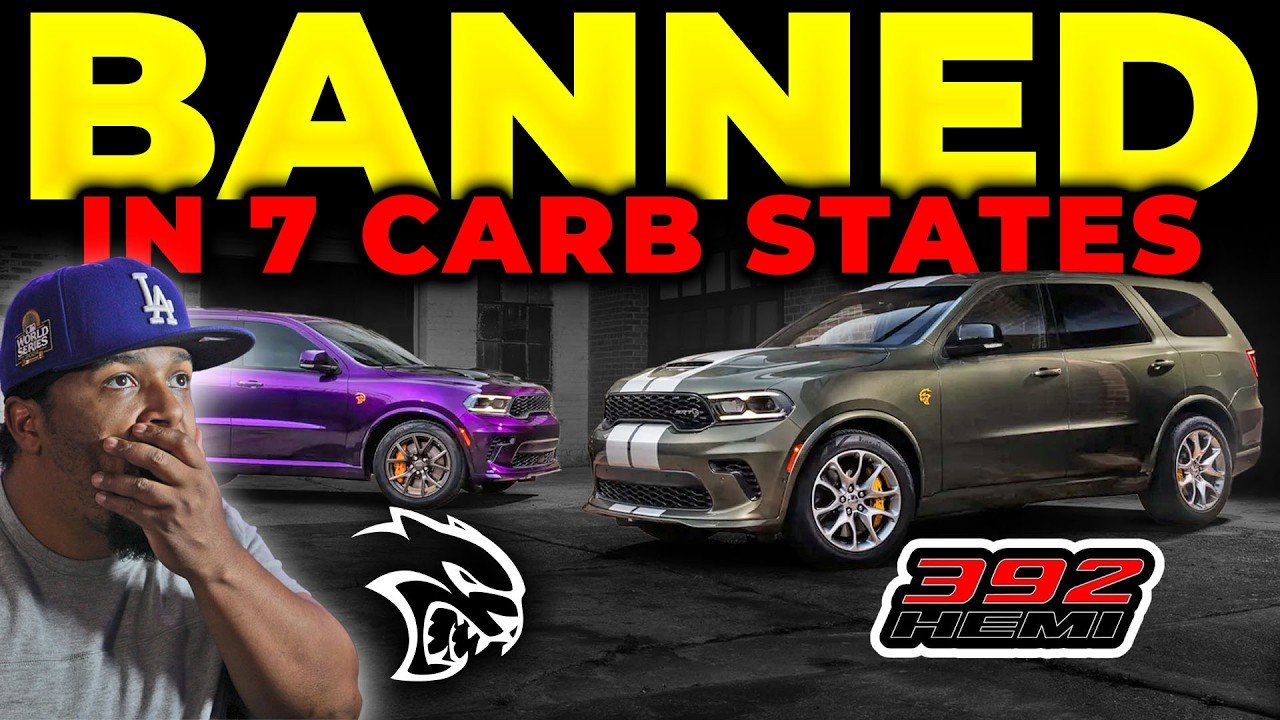
Durango Hellcat in CARB States: Who Flipped, What’s Next for 392, and How Dodge Threaded the Needle
What if I told you the “no V8s in CARB states” era just sprang a leak? Dodge has been negotiating behind the scenes and now 10 of the 17 CARB followers are allowing Durango Hellcat orders again. That’s a massive pivot for a market slice that accounts for roughly 40–45% of potential customers—especially when we’re talking about high-ATP, high-tax vehicles that pump serious revenue into state coffers.
Below, I’ll map which states flipped, why the 392 is still in limbo, and how this likely happened. If you live in a holdout state, there’s also a game plan for getting your order placed without getting burned.
What just changed (and why you should care)
- The flip: A Dodge internal update circulating in dealer channels shows Colorado, Connecticut, Delaware, Maine, Maryland, Minnesota, Nevada, New Jersey, Rhode Island, and Virginia are now taking Durango Hellcat orders.
- The holdouts: Heavy hitters like California and New York (and likely Pennsylvania and Washington) remain on the no-list for now.
- Why it matters: These green-light states unlock pent-up demand for Dodge’s flagship HEMI SUV—precisely the kind of vehicle that juices dealer grosses and state tax receipts.
Bottom line: the “blanket ban” storyline just became a patchwork—and patches tend to spread once money is flowing.



Wait—what about the Durango 392?
Short answer: unclear (for now).
The current green-light specifically names the Durango Hellcat. The Durango 392 (now effectively the R/T by powertrain) isn’t explicitly included in that internal note. If you’re in one of the ten “yes” states and want a 392:
- Ask your dealer if an update has dropped adding 392 ordering codes.
- Be ready to place a sold order the minute it clears—392 supply hinges on engine allocation and emissions sign-off.
- Expect sequencing: Stellantis appears to be rebuilding HEMI inventories after prioritizing 5.7-liter production; 392 approvals may follow once volume, cert paperwork, and parts flow line up.
My read: Dodge knows the 392 is a volume sweet spot (nearly 500 hp at a far lower ATP than Hellcat). The silence here likely reflects staging, not rejection.
How did Dodge pull this off?
This smells less like “science changed” and more like policy pragmatism:
- Tax math talks: Hellcats carry high MSRPs, pricier fuel, and fat insurance—translation: higher tax revenue per unit for states.
- Targeted compliance: CARB-aligned states can cut carve-outs or accept case-by-case equivalencies without abandoning their framework.
- Inventory leverage: With production planning shifting back toward HEMI availability (5.7 now prioritized; 392 rebuilding), Dodge can promise stable fill rates—states hate vapor allocation.
- Political optics: Quiet allowances avoid splashy headlines while giving dealers product they can actually sell.
Call it what you will—negotiated reality is back.
What this means if you’re shopping
If you’re in a green-light CARB state (CO, CT, DE, ME, MD, MN, NV, NJ, RI, VA):
- Lock an allocation immediately. Ask your dealer for a sold order tied to a Hellcat order code, with a written ETA window and price protection language.
- Get the emissions line item in writing. Have them confirm the state compliance code on the build sheet before you sign.
- Plan financing early. These will transact strong; pre-approval beats ADM games.
If you’re in a holdout (e.g., CA, NY, plus likely PA, WA):
- Two viable paths:
- Out-of-state purchase + titling strategy (be sure you fully understand your state’s registration rules, smog checks, and timing).
- Wait for phase two of approvals; watch dealer memos and enthusiast forums for the next batch of states to flip.
- Don’t leave deposits without an order code. If your dealer can’t produce a valid build/sequence, you’re just parking cash.
Why the 392 may be staggered behind Hellcat
A few pragmatic reasons Dodge might bring back Hellcat first, 392 second:
- Inventory cadence: Rebuilding stock of 6.4L (392) long blocks while 5.7 has been the focus.
- Certification sequencing: One certification package at a time is cleaner.
- Price laddering: Lead with the halo (Hellcat), then widen the funnel (392) once headlines cool and production is smooth.
If you’re after 392, keep your powder dry and your paperwork ready; approvals often change from “no” to “go” in a single internal memo.
Dealer playbook: how to keep control of the deal
- Ask for the POC (proof of compliance) detail tied to your state and engine before you sign.
- Insist on a buyer’s order that includes: trim, options, engine, no addendum without consent, and MSRP or agreed selling price.
- Time-bound your deposit. If the store can’t secure a build spot in X days, deposit returns automatically.
- VIN tracking: Once assigned, track your VIN through shipping—CARB paperwork sometimes lags the railcar by days.
What this signals about Dodge’s broader strategy
- HEMI is back in the spotlight. The brand tried an EV/hurricane-first pivot; the market (and margins) pushed back.
- Negotiated regional access is the new normal. Expect rolling updates as more CARB states carve out exceptions.
- Cross-nameplate effects: As we discussed in the Ram street-truck breakdown, the 392 is the logical “bridge” engine for multiple models while the halo Hellcat draws foot traffic.
What to watch next (tells that matter)
- Second-wave state list. If any of CA/NY/PA/Washington budge, the rest will follow.
- 392 bulletin. The moment an internal note adds “392 approved” to the ten states above, order banks will light up.
- Allocation chatter. If dealers start talking guaranteed weekly Hellcat slots, the spigot’s truly open.
- Build mix vs. ADMs. If pricing gets silly, Dodge may boost supply—or quietly cap flipper zip codes.
Quick FAQ
Q: Can I order a Durango Hellcat today in one of the ten states?
A: Yes—dealers in CO, CT, DE, ME, MD, MN, NV, NJ, RI, VA should be able to write a sold order now. Get documentation attached to your buyer’s order.
Q: What about Durango 392 in those states?
A: Not officially green-lit in the same memo. Ask your dealer to watch for the 392 update; be ready to place a sold order the day it hits.
Q: Will California and New York flip?
A: They’re the toughest nuts to crack—but money talks. If this first wave performs, pressure will build.
Q: Is this really about emissions?
A: If it were purely emissions, you wouldn’t see a 10-of-17 carve-out overnight. This looks like negotiated economics more than a sudden scientific revelation.
The takeaway
Dodge didn’t topple CARB. They out-maneuvered the map—and for Durango Hellcat fans, that’s what counts. Ten states are live, seven are holding out, and the 392’s return to those same markets feels like a matter of timing, not ideology.
If you’re in a “yes” state, go place the order—with your paperwork tight. If you’re in a “no” state, watch the next memo and keep your options open across state lines. Either way, the V8 door that slammed in 2024 is creaking open in 2025—and once the revenue starts flowing, it rarely swings shut.